
Modern life feels loud. Notifications buzz, deadlines pile up, and anxiety sneaks in when you least expect it. Many people search for quick fixes, but calm rarely comes from shortcuts. It comes from consistent mental habits.
That’s where calming affirmations come in.
Calming affirmations are not magic words. They are intentional statements that help your brain slow down, reframe stress, and return to balance. Used correctly, they support emotional regulation and reduce anxiety responses over time.
In this article, you’ll learn:
- What calming-affirmations actually are
- How affirmations to calm anxiety work in the brain
- Common mistakes people make
- 50 affirmations you can use daily
Everything here is based on psychology, neuroscience, and mindfulness research, not guesswork.
What Are Affirmations to Calm?
These are short, positive, present-tense statements designed to quiet anxious thoughts and bring emotional stability.
They work by redirecting attention away from fear and toward safety, grounding, and control.
Examples include:
- “I am safe in this moment.”
- “My breath brings me back to calm.”
- “I can slow down whenever I choose.”
Unlike generic positive thinking, affirmations for calm focus on nervous system regulation, not forced optimism.
Why Anxiety Feels So Overwhelming (And Why Words Matter)
Anxiety activates the amygdala, the brain’s threat detection center. When it senses danger—real or imagined—it triggers a stress response.
Your body doesn’t know the difference between:
- A real physical threat
- An anxious thought about the future
That’s why anxiety feels physical: racing heart, tight chest, shallow breathing.
According to the American Psychological Association (APA), repeated anxious thinking strengthens stress pathways in the brain. The good news? The brain also adapts to calming input.
Words matter because language influences neural patterns. Repeated these calmin lines help shift the brain from threat mode to safety mode.
How Calming Affirmations for Anxiety Actually Work
Calming affirmations work through neuroplasticity, the brain’s ability to rewire itself.
Research from institutions like Harvard Medical School and Stanford University shows that:
- Repetitive positive self-statements reduce stress reactivity
- Mindful language lowers cortisol levels
- Self-directed calming statements improve emotional regulation
Affirmations do not suppress anxiety. They acknowledge it and soften its grip.
That’s why effective affirmations feel believable and gentle, not exaggerated.
Calming Affirmations vs. Toxic Positivity
Let’s clear this up.
Calming affirmations are not:
- Ignoring anxiety
- Pretending everything is fine
- Forcing happiness
They are:
- Grounding yourself in the present
- Giving your nervous system a pause
- Replacing panic with perspective
If an affirmation feels fake, your brain rejects it. A good affirmation feels reassuring, not dramatic.
Common Mistakes People Make With Affirmations
Many people quit affirmations because they use them wrong.
Avoid these mistakes:
- Saying affirmations while multitasking
- Using overly dramatic phrases
- Expecting instant results
- Repeating them mechanically
- Fighting anxiety instead of calming it
Calm grows through gentle repetition, not force.
The Role of Self-Compassion in Calming Affirmations
Self-compassion strengthens affirmations.
According to research published in journals like Mindfulness and Clinical Psychology Review, self-kindness reduces anxiety and emotional reactivity.
That’s why effective affirmations sound supportive, not demanding.
Think of affirmations as how you would speak to a close friend during stress.
50 Calming Affirmations for Anxiety and Inner Peace
Below are 50 affirmations to feel natural, supportive, and grounding. These work for daily use, panic moments, or bedtime routines.
Daily
- I am safe in this moment.
- I allow myself to slow down.
- Calm flows through me naturally.
- I can handle what comes my way.
- I choose peace over pressure.
Calming-Affirmations for Anxiety
- My breath brings me back to calm.
- Anxiety does not control me.
- I release tension with every exhale.
- I trust myself to cope.
- This feeling will pass.
Affirmations to Calm Anxiety Quickly
- I ground myself right now.
- I am present and supported.
- My body knows how to relax.
- I let go of unnecessary worry.
- I return to balance gently.
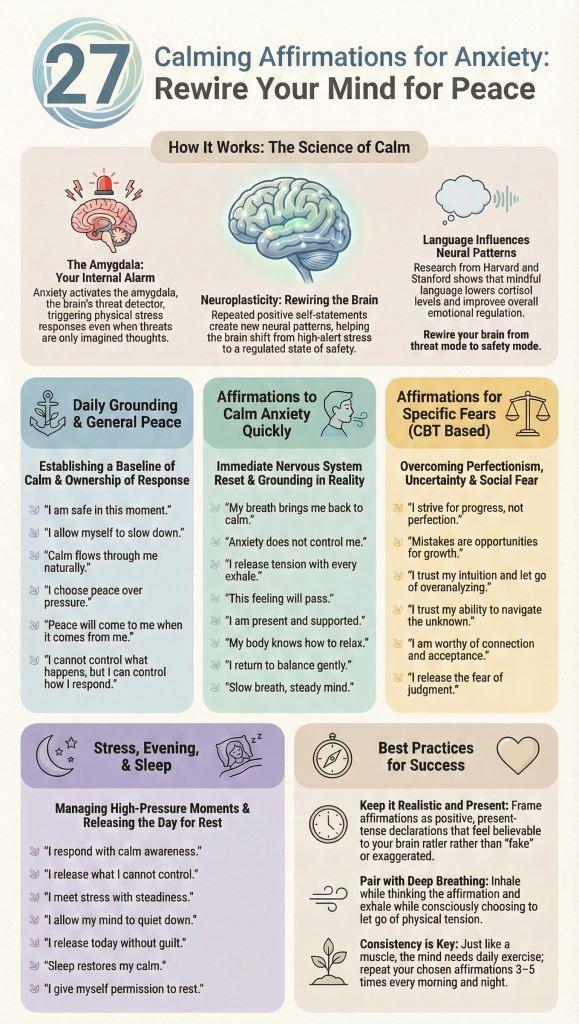
Download Full Size Info-Graphics for Calming Affirmations
Calming Mantras for Anxiety
- Slow breath, steady mind.
- Peace begins within me.
- I soften and let go.
- Calm is always available to me.
- I rest in the present moment.
Affirmations for Calm During Stress
- I respond with calm awareness.
- I release what I cannot control.
- I am stronger than this moment.
- I meet stress with steadiness.
- I remain centered and clear.
Evening & Sleep
- I allow my mind to quiet down.
- My body relaxes naturally.
- I deserve rest and peace.
- I release today without guilt.
- Sleep restores my calm.
Gentle Reassurance Affirmations
- I am not in danger.
- I give myself permission to rest.
- I am allowed to take things slowly.
- I meet myself with compassion.
- Calm returns to me easily.
Inner Peace Affirmations
- I trust the rhythm of life.
- I feel grounded and secure.
- I am enough in this moment.
- I choose clarity over chaos.
- Peace feels natural to me.
Affirmations for Emotional Balance
- I acknowledge my feelings without fear.
- I let calm guide my reactions.
- I breathe through uncertainty.
- I create space for peace.
- I am steady and capable.
Closing
- I am supported and safe.
- I welcome calm into my body.
- I release tension gently.
- I return to stillness now.
- Calm lives within me always.
Are Calming Affirmations Supported by Science?
Yes—when used properly.
Studies from reputable sources such as:
- American Psychological Association (APA)
- Harvard Health Publishing
- National Institutes of Health (NIH)
suggest that positive self-talk, mindfulness, and cognitive reframing can reduce anxiety symptoms and stress responses.
Affirmations work best as part of a broader mental wellness routine, not as a replacement for professional care.
How to Build a Daily Affirmation Practice
You don’t need hours.
Try this simple routine:
- Choose 3 affirmations
- Repeat each 3–5 times
- Pair with slow breathing
- Practice once in the morning and once at night
Consistency creates calm.
Final Thoughts: Calm Is a Skill You Can Practice
Calm is not a personality trait. It’s a trainable mental state.
Calming affirmations help you interrupt anxiety, soothe your nervous system, and return to clarity. They don’t eliminate stress, but they change how you relate to it.
With patience and regular practice, affirmations for calm become second nature.
And sometimes, that quiet inner voice saying “I’m okay” is all you need.
A really good blog and me back again.